
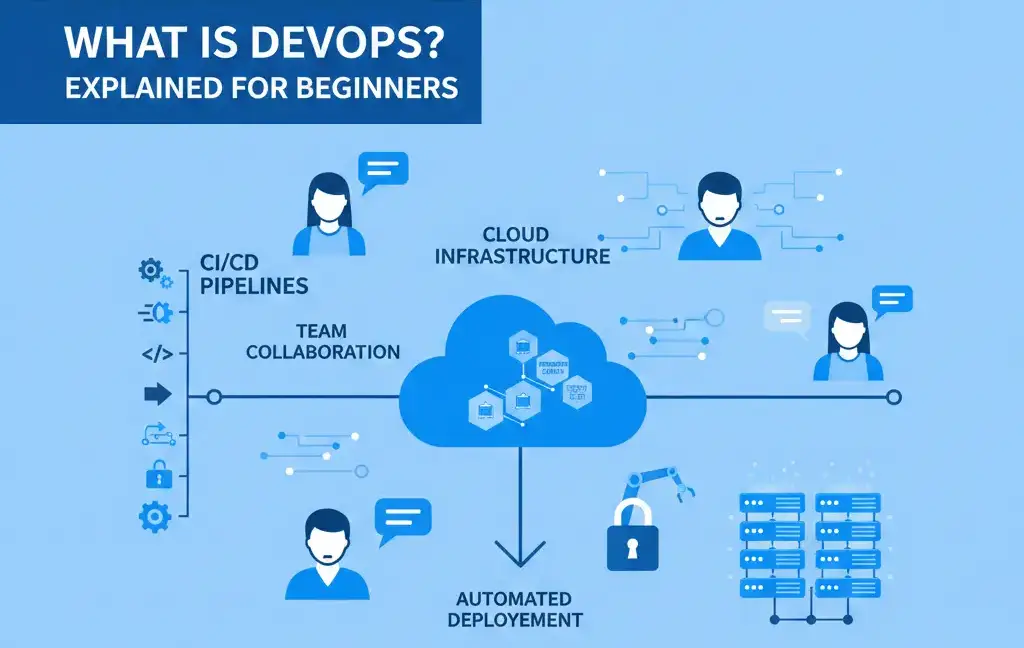
DevOps Explained for Beginners: The Ultimate Guide
DevOps has become one of the most influential approaches in modern software delivery, enabling teams to release faster, reduce bugs, strengthen security, and scale applications with confidence. Whether you’re beginning your journey into cloud engineering or you’re an experienced developer aiming to optimize automation, DevOps provides a structured framework that unifies development, operations, and security into one continuous lifecycle.
This Ultimate Guide explains DevOps in a simple, practical, and beginner-friendly way—covering what DevOps is, how it works, why it matters, DevSecOps, real-world use cases, business benefits, adoption timing, and essential tools used by modern teams.
✅ What Is DevOps?
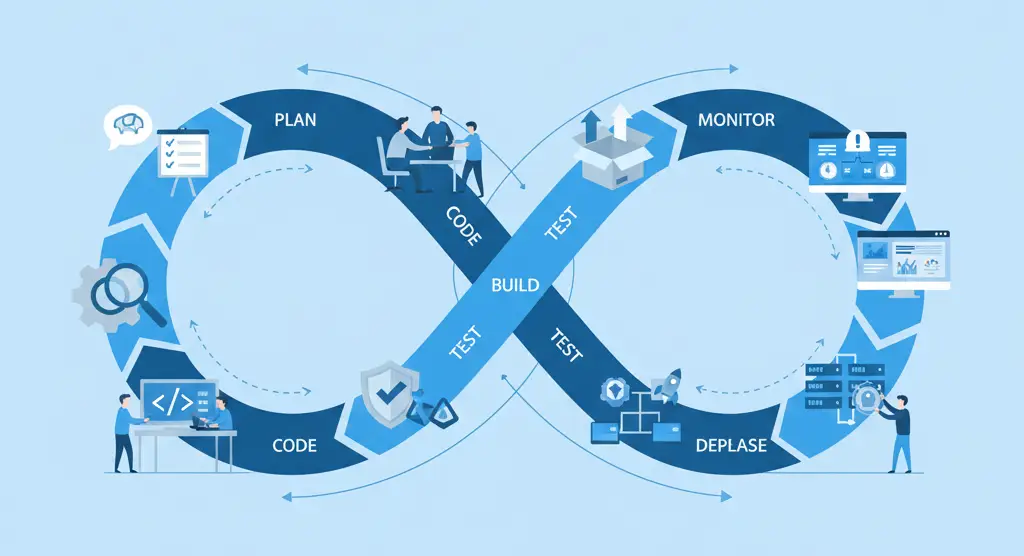
DevOps is a collaborative approach that brings together development, operations, and security teams so software can be built, tested, deployed, and monitored in a seamless, automated, and reliable manner. Instead of teams working in isolation, DevOps promotes shared responsibility, continuous delivery, and automation at every stage.
In a complete DevOps environment, teams move through a continuous loop of stages—Plan → Code → Build → Test → Release → Deploy → Operate → Monitor—supported by advanced tooling, automation, and collaboration.
By removing friction between developers and operations engineers, DevOps helps software move from idea to production with minimal delays, fewer bugs, and consistent stability.
✅ Why DevOps Matters
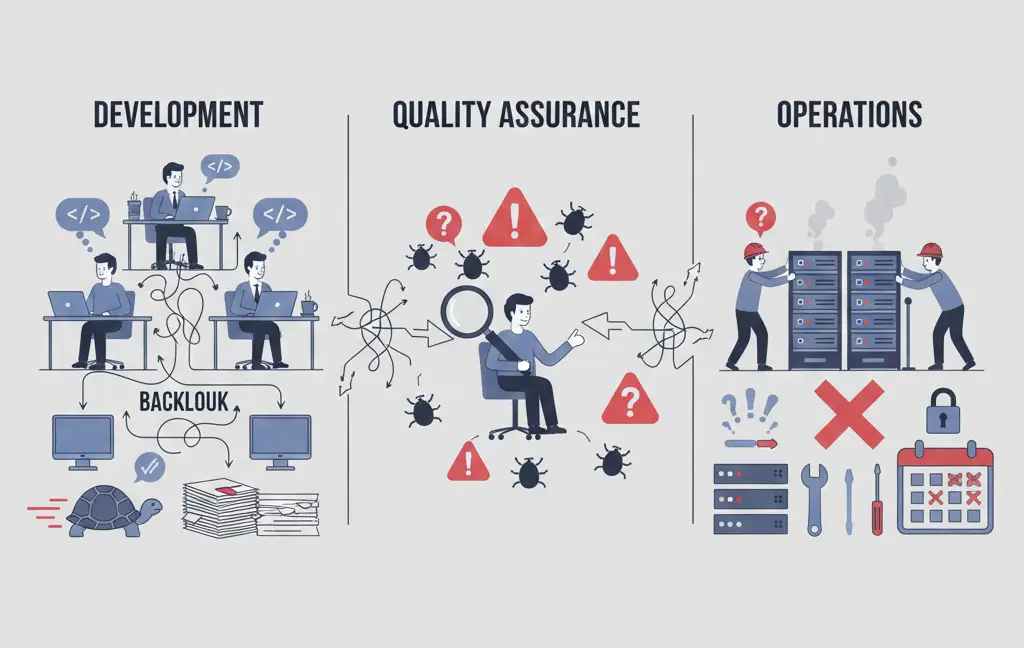
Before DevOps, organizations used a traditional, fragmented process:
- Developers wrote code
- Testers validated it mid-project
- Operations deployed it manually
- Security teams reviewed it at the end
This created major challenges:
- Slow release cycles
- Frequent production bugs
- Miscommunication between teams
- Manual, repetitive tasks
- Configuration drift
- High operational overhead
DevOps solves these problems by combining teams, streamlining tools, and automating every step. The result is a repeatable, consistent, and highly reliable software delivery pipeline.
⭐Core Goals of DevOps
- DevOps is built on a clear set of goals that improve both engineering efficiency and product quality:
- Faster and more reliable software delivery
- Automated testing, deployment, and security checks
- Improved cross-team collaboration
- Reduced deployment failures
- Cloud-native, scalable infrastructure
- Proactive security through DevSecOps
- Predictable and repeatable pipelines
- These goals help businesses innovate faster and maintain long-term system stability.
🛠️ Key DevOps Concepts
1. Continuous Integration (CI)
Every code commit triggers automated tests, allowing teams to identify issues early before they reach production.
2. Continuous Delivery / Continuous Deployment (CD)
Software updates are automatically built, tested, and deployed—sometimes multiple times a day—making releases predictable and stress-free.
3. Infrastructure as Code (IaC)
Servers, networks, and cloud infrastructure are managed using code tools like Terraform and Ansible, ensuring consistent and reproducible environments.
4. Monitoring & Observability
Metrics, logs, and tracing ensure that teams have real-time visibility into system health, performance, and user behavior.
5. Automation Everywhere
Testing, deployments, scaling, security scans, compliance checks, and auditing are all automated to remove manual bottlenecks.
🧰 Popular DevOps Tools
Modern DevOps workflows depend on powerful tools across CI/CD, cloud infrastructure, automation, and security.
CI/CD Tools
- GitHub Actions
- GitLab CI
- Jenkins
- CircleCI
Containerization
- Docker
- Podman
Orchestration
- Kubernetes
- K3s / K0s
- Amazon EKS / Google GKE / Azure AKS
Infrastructure as Code
- Terraform
- Ansible
Monitoring & Logging
- Prometheus
- Grafana
- Loki
- Datadog
Security & DevSecOps Tools
- Trivy
- SonarQube
- Snyk
These tools automate workflows, ensure consistency, and help teams deploy applications safely and efficiently.
🧪 How DevOps Works in a Real Project
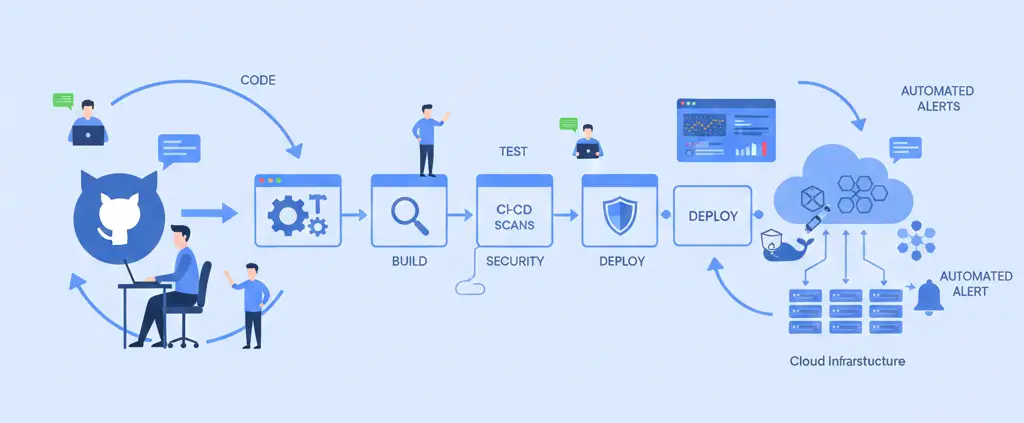
To understand DevOps in a practical setting, imagine a simple website that requires frequent updates.
Without DevOps
- Developers push code manually
- Operations deploy manually
- Testing happens late
- Bugs slip into production
- Teams spend hours fixing issues
Everything feels slow, unpredictable, and risky.
With DevOps
The workflow becomes automated and predictable:
- Developer pushes code
- Automated CI pipeline runs unit tests and security checks
- Build system packages the application
- Kubernetes deploys and scales it automatically
- Monitoring tools provide real-time insights
This reduces failures, speeds up delivery, and ensures a stable user experience.
🔐 DevSecOps: Security in Every Stage
DevSecOps integrates security from the start instead of treating it as an afterthought. Security automation ensures:
- Code scanning
- Dependency checks
- Container image validation
- Cloud configuration audits
- Vulnerability detection
This prevents security risks early, reduces costs, and ensures compliance without slowing down development.
By embedding security into every stage, DevSecOps strengthens the entire pipeline while maintaining high delivery speed.
📈 Benefits of DevOps for Businesses
DevOps provides significant advantages for businesses across industries. The impact is both technical and strategic:
1. Faster Releases
Automated pipelines, CI/CD workflows, and containerized deployments eliminate manual steps, enabling rapid delivery of new features and fixes.
2. Higher Reliability
IaC, automated testing, and versioned deployments guarantee consistency and reduce unexpected outages.
3. Lower Costs
Automation reduces manual workload, improves resource utilization, and minimizes downtime—resulting in operational cost savings.
4. Stronger Security
With DevSecOps, security checks are integrated into the pipeline, preventing vulnerabilities early instead of after deployment.
5. Better Team Collaboration
Development, operations, and security teams work in a unified environment, improving communication and reducing friction.
6. Superior Customer Experience
Faster updates, fewer outages, and quick incident resolution lead to higher user satisfaction and trust.
In short, DevOps becomes a strategic advantage that drives innovation, resilience, and long-term business growth.
🧭 When Should a Business Adopt DevOps?
A business should adopt DevOps when traditional development practices start slowing down progress or affecting product quality. Common signs include:
- Long deployment times
- Frequent production failures
- Manual, repetitive operations
- Limited visibility into system health
- Siloed development and operations teams
Startups
Should adopt DevOps early to maintain stability as user traffic grows and features evolve rapidly.
Growing Businesses
Need DevOps when scaling infrastructure or managing multiple releases each month.
Enterprises
Benefit from DevOps when modernizing legacy systems or transitioning to cloud-native architectures.
Organizations With High Security Requirements
DevSecOps ensures continuous compliance and proactive vulnerability detection.
Overall, the best time to adopt DevOps is before engineering teams become overwhelmed or systems become too complex to manage manually.
To explore how DevOps can be applied to your organization, visit our services page.
🚀 Conclusion
DevOps transforms how software is built, tested, deployed, and maintained. It replaces manual, error-prone processes with automation, collaboration, and continuous improvement. By integrating security through DevSecOps and leveraging cloud-native tooling, teams create scalable, reliable, and high-performing systems.
Organizations that adopt DevOps experience faster releases, fewer failures, and more efficient resource usage. Developers gain smoother workflows, operations teams gain stability, and businesses gain agility to innovate rapidly.
For beginners, the idea is simple:
DevOps helps teams build and ship software smarter, faster, and with fewer mistakes.
This guide provides the foundation to understand DevOps clearly and confidently—whether you’re learning it for the first time or preparing to implement it within your organization.